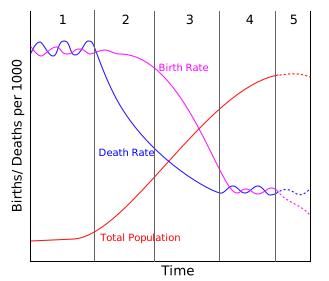
In 1971 a new Population Model was put forward, covering Population, Health and Disease. The model states that societies undergo three 'ages' of health:
1) An age of famine: Mortality is high, with deaths usually being caused by infectious diseases and conditions associated with nutritional deficiencies.
2) An age of receding pandemics: Improvements in medical sciences and healthcare result in less pandemics and an increase in life expectancy.
3) An age of degenerative diseases: As people live longer through better healthcare, degenerative diseases increase in visibility. Diseases of Affluence also begin to become prominent.
It has been put forward that Socio-economic development is responsible for the progression through the 'ages', whilst in other ways it parallels the Demographic Transition Model. These are things such as high mortality levels with young populations and low mortality and birthrates with ageing populations and a surge in non-communicable diseases. Medical Revolutions have taken place in the middle of both the models, with controls being placed on infectious diseases/ being wiped out completely.
In my opinion, this is an ingenious model as it doesn't just look at death rate and birth rate, like the Demographic Transition Model, but also looks at the causes for these deaths and therefore also the birth rate. It looks into how the society exists at that particular time, with its concentration on disease being an easy measure of the condition of the healthcare system and the life expectancy. For me it is also more accurate, as it takes in more conditions, meaning that it can give a more insightful look at a country as it travels through the 'ages'.
