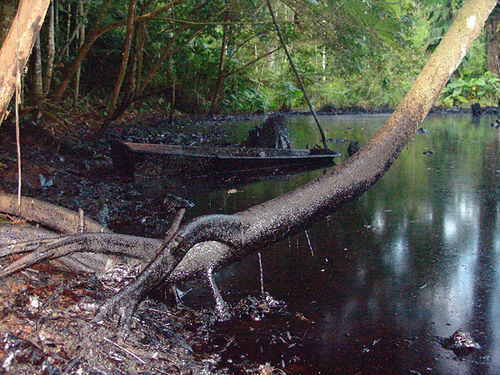
During the period of time between 1964 and 1990, Texaco dumped more than 18 billion gallons of toxic waste directly into the Amazon rainforest. It is part of a hotly debated court case and has been referred to as “The Chernobyl of the Rainforest”. But is this justified?
First of all, let’s look at how we can categorise this incident. It could be put either in a “Hazard” category or maybe a “Disaster” category. I personally think that this is still in the “hazard” category, and here’s why. A disaster could be described as a situation which has lead to irremediable damage to an area or people. Yes, the oil spill has and continues to damage the environment and area, but it is still at a stage where repairs could be made to the area and limit the impact the oil has had.
Yet this is not to say that damage has not already been caused to the Rainforest and its people. On the human side many people are claiming that the oil has increased cancer rates amongst those who live closest to the oil dumps. Research has been put into this and the results have been inconclusive, although it seems that only the research funded by Chevron (Texaco’s owner) has been able to say there is no apparent correlation. Even though there are results which show that in areas there are dangerously high levels of cancer causing hydrocarbons. Yet the environmental impacts are even harder to see. Evidence shows that the ecosystem of the forest has been adversely affected. As insects and small animals become rarer due to increased death rates caused by the toxicity of the fuel, larger animals higher up the food chain start to be adversely affected. As they lose food sources the find it harder to survive and the whole ecosystem collapses.
The evidence to support the claims of the people affected seems to carry more weight than that of Texaco’s, with much of their evidence seeming to try and push the blame onto someone else, usually PetroEcuador. Most studies are in favour with the natives, and often the best evidence for Texaco covers an “inconclusive evidence” stance.
Was this predictable? At first it seems that they were just following standard practise and using the same procedures as they do elsewhere. However, it has now come through that these standard practices were not being followed to the letter. In most places they will dig pits to dump the toxic waste into, just like they did in Ecuador. However, in Ecuador, they didn’t line these pits, which is what has allowed the toxic waste to leak and caused all of the problems. If they had lined the pits in the first place, this situation would probably never have arisen.
The victims could be seen as a vulnerable population as well, due to their general existence. Most of the people lead basic lives involving farming and other basic employments. Due to this they don’t have as much money as other people, the people that have caused the problem. They are therefore vulnerable in the way that they cannot afford to repair the damage that has been caused by the toxic waste.
So, what have Texaco done to help repair the damage? They claim to have cleaned and restored over 120 sites around Ecuador. However, there are still over 800 sites to clean, which suggests that what has been done has been highly inadequate. Similarly, to date no action has been taken to help the people who have been affected by this. Charities are trying to help by providing clean water but other than this there is very little else being done. Texaco never even kept a log of where all the pits are, so it is very difficult for locals to avoid them.
Does this make Texaco legally responsible? Well, this may be one of the only parts where their argument stands up to any scrutiny. They were part of a duo of companies in the area who were working together, Texaco and PetroEcuador. As Texaco had the smaller share in the business this does suggest that they are maybe not as legally responsible as people would lead you to believe. However, they are still morally responsible. Even though they had the smaller share (40%) they appear to have controlled almost all of the oil sites around Ecuador. This suggests that they are still morally responsible for the pollution, even if legally they are responsible for less than half of it.
So who should win the court case and who will win will hopefully be the same, although the shear might of Chevron may be enough to overthrow the underfinanced prosecutors. From this statement it may be obvious as to where I stand on this topic, as I feel that there is enough evidence to have the Ecuadorians win, with either company paying resulting in a form of victory. However, this will almost definitely not be the end of the argument. For as long as there is still damage to the environment and the people the conflict will still rumble on.
Is it happening elsewhere? Well, as long as there are companies in the world and a world for them to operate in things will continue to happen. These may be accidents, like the Chernobyl Disaster, or perhaps less accidental, like this (Texaco in Ecuador) appears to be. It appears that companies are going to have to pay for their environmental damage in their production of carbon dioxide, with heavy taxes on the worst polluting companies. This could be seen as the start of a global change as companies become more environmentally aware.
For more information, Please Visit: ChevronToxico
